what is the difference in school choice and board to board transfer
The British vs. American Education Systems: Reference to IGCSE vs. SAT Exams
Introduction:
This article is virtually British vs. American Education Systems: Reference to IGCSE and SAT.
It is a result of the countless online questions and common confusions.
What are the British and American Education Systems similar?
How does the Sat exam compare to the IGCSE examination?
We at Tutopiya find that this question is a mutual query amongst students, parents, and teachers.
This article aims to fill the gaps in the lack of information on British vs. American Education Systems with reference to IGCSE and Sabbatum exams.
A read through this commodity will provide the following data:
- What are the British and American Didactics Systems
- With a focus on the ii most widely recognized assessments: IGCSE and Saturday exams
- How these two examinations are non comparable, in contradiction to popular notions.
- Data about the IGCSE and Sat exams.
- Why Tutopiya is a trustworthy source of support on Online Tuition and Information for the above exams.
Both the British and American Teaching Systems boast a rich history of a tradition in educational activity and assessments.
Their assessments, curriculums, and educational support to centres and schools are recognized around the globe.
Aspiring university students sit for exams that can facilitate their entry into universities in the United States and the United Kingdom fifty-fifty today.
And then what exactly are these two Didactics Systems all about?
That too in the reference of IGCSE and Sat exams
How do the IGCSE and SAT compare to one other?
Especially, since they are the well-nigh widely sought after exams worldwide from the British and American education systems.

British Education System:
WHAT IS THE BRITISH Educational activity SYSTEM?
The British education system has been a pinnacle of providing a world-form education for many years.
This instruction system boasts a global reputation for excellence in education.
As a result, it is a very pop choice among international students as well.
The Great britain is home to some of the prestigious universities in the globe.
Both Oxford and Cambridge Universities are historical monuments that take paved the way for intellectual and scientific advancement from early times.
These universities and several others in the Britain are starting time-manus choices of many students across the world.
The British education organisation tin exist classified into Foundation, Primary, Secondary, Farther and Higher Instruction levels.
Each education level has a Fundamental Stage the students have to pass.
Children in the United kingdom have the pick of attending either state-funded or private schools.
Mostly, students start school from the age of iii until they are 16 years erstwhile.
Information technology is legally mandatory for children to complete their Secondary Educational Level.
Later which if they wish to quit schooling they can and join the workforce.
They could too bring together state-owned vocational training centres.
Or they could follow the pedagogy system and consummate their Further and Higher Education.
If yous are planning to enrol your child into an international school that follows the British curriculum and so its best y'all enrol them by the age of 3.
Structure and depth of knowledge are important aspects of the British education system.
Additionally, information technology has a well-designed construction or 'Key Stage' programme that contains the major learning milestones.
These milestones or 'primal stages' assist a child develop a holistic education at every stage in life.
Equally a upshot, information technology propels brighter students and supports students with special learning or different teaching needs.

COMPONENTS OF THE BRITISH Didactics SYSTEM
Every bit mentioned to a higher place the British Education Organisation contains dissimilar educational levels.
These arePrimary, Secondary, Further and Higher Educational Levels.
The educational level and cardinal stages volition be discussed in this role of the commodity
-
Primary Education
Primary education in the British education system starts at the age of 3 and continues till age 11.
Within this level, the Foundation/Reception Level and Key Stages ane and 2 are completed.
Foundation/Reception Level: 3 to 5 years
Cardinal phase: 1 is from five to vii years
Central phase: 2 is from 7 to xi years
- Foundation or Reception
Foundation is the name given to the commonly known Playgroup or Nursery education.
As mentioned in a higher place the Foundation phase takes place from the age 3 to 5.
It is at this level that students are introduced to preschool teaching through both indoor and outdoor play activities.
These activities guide the child's personal, social and emotional evolution and create an awareness of the environs they alive in.
Every bit a issue, the foundation stage acts as a stepping stone to the further educational levels.
The key stages one and 2 are completed at Primary Education level, in the Primary school.
- Primary Education
Primary Instruction introduces students to basic numeracy and literacy.
Foundations to science, mathematics, languages, geography/history, arts and crafts, literature, and health and wellbeing are too established.
Students will be assessed through several assessments created by the teacher at the end of every Cardinal stage.
A range of assessments are utilized and teachers make profiles/ report cards of each student to mark progress, summarize achievements and constructive feedback.

2. Secondary Pedagogy
From ages 11 to 16, students will enter secondary school for Fundamental Stages three and 4.
Secondary Education is an important milestone.
Information technology is in this stage that resident students of the United Kingdom, begin their journey towards the General Certificate of Secondary Education (GCSE).
The International General Document of Secondary Educational activity (IGCSE) is the equivalent of GCSE in international schools worldwide that follow the British education organization
Primary and Secondary education is mandatory in the UK.
Afterward xvi years of age farther education is optional.
Students anile 11 to xiv will study a broad range of subjects in the first few years of Secondary school.
Subjects such as Music, Maths, Scientific discipline, English, together with other subjects they have studied throughout Main schoolhouse.
When reaching 14 years, students will commonly enter into their first year of the two-year course known as the GCSE or IGCSE.
In international schools that follow the British teaching system the IGCSE'due south are a vital assessment.
Firstly, information technology is a benchmark to show that a student has a foundation to study further.
Secondly, the IGCSE'south are a symbol of achievement that shows that the student has the required noesis to join the workplace.
Here the students will report a combination of subjects.
Commonly, it is a combination of 5 to x subjects depending on the student
Students have to take upwards the two main compulsory subjects like Math and English.
The required Scientific discipline subjects like Physics, Chemistry and Biology can exist studied together or separately.
As well every bit a preferred combination of boosted subjects similar French, High german, Literature, Business organisation Studies, Pattern, Information and Technology and many more than.
Once students complete the GCSE/IGCSE exams, they will accept completed all required Key stages of the British Education System.
In international schools worldwide students opt to go for the advanced level studies.
Such as the Cambridge or Pearson Advanced General Certificate of Didactics and the International Baccalaureate.

three. Further Instruction
The farther teaching level contains a lot of options for students from ages xvi to 18 years.
These options are:
- Further Academic Study
- Vocational Training
- Joining the Workforce
Every educatee has the liberty to cull whichever pathway that is near suitable for them.
Students wanting to study farther can choose the options of Vocational Training or Academic Qualifications
-
Farther Bookish Report
Schools in the Britain have a '6th Form' for students to enter later on they complete the GCSE / IGCSE.
In the 'sixth Form' students take the Avant-garde Level Examinations.
Advanced Level Exams betrayal students in acquiring knowledge that is useful for higher pedagogy or tertiary education in a degree program.
Advanced General Certificate Examinations (GCE) is similar to the GCSE/ IGCSE.
Firstly it is a ii-year program.
Secondly, students in this stage likewise accept up subjects that they wish to study in-depth.
Depending on the grit and determination of the student, the number of subjects varies from three to five or more.
Generally, students pick iii subjects which are compulsory.
However, due to personal preference, they may choose more than three besides, depending on their decision and grit.
-
Vocational Qualifications
For students who are non and so academically minded, they even so have another selection.
Vocational Qualifications!
Students can accomplish a more easily-on and more versatile educational feel when studying for a Vocational Course.
Some of the courses that count as vocational courses are Beauty therapists, Stylists, Technicians, and Mechanics.
-
Higher Instruction
After completing the Advanced Level GCE examinations students ready to enter University.
The U.k. has a vast number of Higher Instruction options for both local and international students.
College educational activity is broken down to 3 levels:
- A Bachelor's Degree Plan (BSc. Or BA.) 3 to 4 years (Depending on Establishment)
- A Primary's Degree Program or Graduate School (MSc.) i to two years (Depending on Institution)
- A Doctorate Degree Program (PhD.) 3 to iv years (Depending on Institution)
After completing a Bachelor's Degree, students may complete the other Higher education qualification or choose to join the workforce.

IGCSE: INTERNATIONAL General Document of SECONDARY EXAMINATIONS
What is this IGCSE Examination?
It stands for the Cambridge International General Certificate of Secondary Education (IGCSE)
Pearson Edexcel also offers a similar examination chosen the International General Document of Secondary Pedagogy (GCSE)
These two are the most popular examinations in the world today.
They are offered around the globe and prepare a benchmark for cess, achievement, and recognition.
This standard is accepted by international universities educational institutions and employers worldwide.
IGCSE's are a multifaceted assessment approach that provides vital education for students from ages fourteen to sixteen.
Furthermore, this approach promotes and helps build an array of vocational skills, encourages critical thinking, and creative problem-solving.
Cambridge and Pearson Edexcel boards of Examinations are two virtually competitive and highly accredited boards of examinations.
Both these boards offer IGCSE and GCSE examinations respectively.
-
CAMBRIDGE IGCSE:OVERVIEW AND SUBJECTS
The Cambridge IGCSE curriculum offers a variety of pathways for students within the ages of fourteen- sixteen years.
Taken essentially in the Secondary Level of the Education Organisation, IGCSE exams are the nearly important exams to finish Secondary school.
Cambridge International Examinations (CIE) board is responsible for the germination of the IGCSE.
It is a 2- twelvemonth programme which is vexed, verified and reliable past international schools that follow the British Curriculum worldwide.
Cambridge IGCSE offers a flexible and stimulating curriculum, supported with fantabulous resource and grooming.
There are over 70 subjects offered in the Cambridge IGCSE curriculum, including xxx languages, and schools can offer them in any combination.
Well-nigh international schools following the British Didactics System in Singapore and around the world offer the Cambridge IGCSE exams.
IGCSE allows for diverse forms of cess such as written, oral, coursework and practical assessment, thereby providing them with wider opportunities.
The Cambridge International Certificate of Didactics (Cambridge ICE) document is awarded to students who enter and sit for aminimum of seven subjectsselected from the five IGCSE curriculum areas:
- Languages – Group 1
- Humanities- Grouping 2
- Sciences- Grouping 3
- Mathematics – Group 4
- Creative and Vocational – Group v
Students must accept at least 7 Cambridge IGCSE subjects.
Including ii from Group i and one from each of Groups 2 to 5.
A 7th subject may be chosen from any of the groups.
-
ASSESSMENT AND GRADES
Cambridge IGCSE exams have place at the cease of the course and can include written, oral, coursework and applied assessment.
In many subjects, at that place is a selection between core and extended curriculum.
Making Cambridge IGCSE suitable for a wide range of abilities.
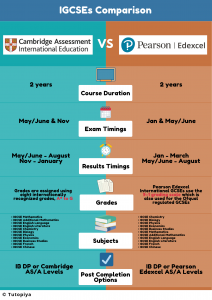
Examination sessions occur twice a year, in June and November. Results are issued in August and January.
Grades are assigned using eight internationally recognized grades, A* to One thousand.
Cambridge IGCSE Core students are assigned grades C to G with C being the highest grade.
Extended students in the Cambridge IGCSE are graded A* to E with A being the highest class.
-
PEARSON EDEXCEL GCSE: Overview & Subjects
Pearson Edexcel International Full general Document of Secondary Education was also previously known as Edexcel IGCSE.
However, it has at present changed to Edexcel International GCSE and is equivalent to the Cambridge IGCSE qualification.
These exams are equivalent to Great britain GCSEs and are accustomed by universities worldwide.
Moreover, Edexcel GCSE is only bachelor for United kingdom schools
There are 40 subjects in the Edexcel International GCSE curriculum.
The international curriculum is for international students in schools post-obit the British Instruction system around the world.
GCSE'due south are aimed at students anile 14 to 16 years in the Secondary Education Level.
Basically, the Pearson Edexcel assessments are a stepping stone to the Further Teaching and College Education levels.
Acting as a backbone for the knowledge the students will gain in the time to come, GCSE'due south are a staple certification.
Students volition need this qualification when they choose to finish studying and start working.
-
Cess & Grading
Assessment in the form of examinations takes place at the end of the ii-year course.
That includes written, oral, coursework, and practical assessment.
Examinations are held in Jan and June.
Pearson Edexcel International GCSEs are awarded using the new 9-point grading calibration (9–i).
Only the concluding assessment contributes to the final form.
Notwithstanding, within the terminal assessment, the contribution of components varies between subjects.
CLICK HERE TO Become Admission TO THE Best CAMBRIDGE IGCSE AND EDEXCEL IGCSE PREP BOOKS
Top v British Curriculum Schools in Singapore:
- Dover Court International School Singapore
- Dulwich Higher
- Marlborough College Malaysia
- One World International School
- Tanglin Trust Schoolhouse

American Educational activity System:
WHAT IS THE AMERICAN Education SYSTEM?
The American Education system is the other most sought after the international pedagogy organization in the earth.
Most of the schools and institutions are governed by state laws and regulations in the U.s..
Like every education organization, there is a basic structure that the American Didactics Arrangement follows.
Boasting a long history of research, innovation and literature the American education system has several accolades to its name.
Many students reach out to the American education organization for its diversity and flexibility of the curriculum.
Multifariousness and Flexibility in terms of the subjects, assessments, and learning approaches are some of the key characteristics of the American education system.
Students are allowed to learn a lot more and explore more subject choices, for instance.
On the contrary to the British education organisation that focuses on the depth of a particular subject.
Like the British teaching system, it is legally mandatory for students to complete their didactics until 16 years of age in Junior Loftier.
A student is only introduced to conventional education at the tender age of 3 years sometime in Pre School /Pre-Kindergarten education level.
After which the students are introduced to formal educational activity from the age of 5.
Unlike the British Education system that goes co-ordinate to the 'key stages,' the American education system is different.
The structure and arrangement of the educational levels depend on the individual states of the Us.
In that location are no Key stages in the American Pedagogy organisation.
By and large, most state-funded schools follow the K-12 Arrangement (Kindergarten to Grade 12) that makes up the American instruction system.
COMPONENTS OF THE AMERICAN Instruction SYSTEM
K – 12 (KINDERGARTEN TO Course 12)
-
PRE K – PRE KINDERGARTEN / PRESCHOOL
The Preschool/ PRE Kindergarten stage introduces the toddler to all sorts of formal and informal education before bodily schooling begins.
Students are roughly iii years of age when they are enrolled at this level.
Activities or the preschool program generally includes craft, music, educational games, perceptual-motor activities and listening skills.
Till 5 to 6 years of age students receive their Pre- School or Pre-Kindergarten Education.
Later which they motion to Chief School.
1.Unproblematic Didactics
Elementary education makes upwardly for the majority of a student's educational journey.
This level of teaching is also called Chief School.
Starting from Kindergarten all the mode to Grade 12, for example, main schoolhouse begins from ages 5 or half-dozen to 10 or 11 years.
Master school begins with Kindergarten.
After which it progresses to grade 5 in one institution, depending on the structure of the policy created by the local State or County.
So there is a shift to another section or institution which is called Middle School for Secondary education.
Here, students make the transition from primary didactics to secondary pedagogy.
The bones curriculum of whatsoever main schoolhouse volition cover fundamental concepts in Arithmetic
and Algebra, English language language, Sciences, Music, Art, Languages and Physical Instruction.
-
American Common Core Curriculum
By dominion, the local Country government is responsible for the schoolhouse curriculum in their territory.
Even so, the U.s.a. federal government has taken several steps to standardize the school curriculums across the nation.
Get-go of all, the American Mutual Core is an initiative past the government which decides what each child should know.
Math and English are the ii core curriculums that are regulated by the State and are standardized across the country.
By the finish of each grade level, the Land decides how much of the English and Math curriculums the kid learns.
This applies to grades from Preschool up until Class 12.
It seeks to institute steady educational standards beyond the States.
Furthermore, it'due south established to ensure that students graduating from loftier schoolhouse have adequate
knowledge to enter conventional colleges, vocational higher or to enter the workforce.
ii. Secondary Education
Secondary teaching is the proper noun given to the stage that comes after Chief school.
Pupils entering Secondary education are from ages eleven to sixteen years.
Ordinarily, secondary educational activity is divided into two sections.
The first section is called Centre Schoolhouse or Inferior Loftier Schoolhouse
This section consists of 6th to 8th grades for students anile 11 to 14 years
The second section is called High School.
Grades ranging from the ninth to twelfth grades for students anile xiv to xviii years will be found here
Legally, compulsory didactics is only till the age of 16 years.
It should be noted that every land or district has its ain structure and system.
Even when it comes to education levels and appropriate age categories for those corresponding levels.
-
Centre/Junior High School
Middle Schoolhouse includes the sixth and 8th grade.
Due to the divergence in the country a middle school tin can also include grades 5th and sixth as well.
Students are generally around the ages of 11 to 14 years in Middle School.
Speaking of educational activity and curriculum, the secondary schoolhouse curriculum of a Middle School depends on the different States.
Generally, students in Junior High will be attention several classes with different teachers teaching different lessons.
Some of the subjects that are taught in junior schoolhouse are the core subjects like English, Mathematics, Social Sciences, History and Physical education.
Moreover, students can likewise take advanced subjects and foreign languages.
Some of the advanced subjects and languages that students take the pick of choosing are:
- Advanced Math
- Advanced Science
- Geometry
- Algebra i
- Pre -Algebra
- Spanish
- Latin
- Chinese
- French
At the end of Junior High, teacher and State assigned examinations to decide who transitions into High School.
Later the successful completion of the Inferior High curriculum and assessments, students are awarded a Middle School Completion Diploma.
Unlike secondary school students who sit for the IGCSE, students in the United states are assessed through various other assessments.
-
High School
Students inbound Loftier school autumn within ages fourteen to eighteen years.
They progress from form 9 all the way to 12.
Graduating from High school volition give students a High School Diploma.
This is an entry-level qualification for students who wish to apply for Academy or Vocational Higher.
Pupils take a few mandatory subjects like English, Maths and Sciences.
Together with boosted subjects such equally Arts, Theatre, Geography, History, U.South. History, Concrete Teaching, Avant-garde Sciences, Advanced Math and languages.
Additionally, students are as well exposed to Health Sciences.
Health Sciences consists of subjects similar Anatomy, Nutrition, First Assistance, Drug Sensation, Sexual activity Pedagogy and Birth Control.
Moreover, other Advanced Placement (AP) subjects are likewise bachelor for more than gifted students.
Advanced Placement is the proper noun given to subjects or courses that are more challenging than regular Loftier schoolhouse courses.
These are usually offered in the 11th and 12th grades and mimic courses that are similar in Universities.
On completion of the avant-garde placement courses, students receive Avant-garde Placement Honors alongside their High School Diploma Certification.

3.University / Higher
Higher education in the U.s. is recognized worldwide for its quality and diversity.
Students from around the world flock to the Usa to study for their undergraduates and graduate studies.
The U.s. of America is home to some of the well-nigh prestigious universities or colleges in the world.
Entry into these Universities is monitored and regulated by the College Board.
This organization prepares, guides, and assesses students before they enter academy/college.
One such college preparatory assessment is the Sat test.
It stands for Scholastic Assessment Test and is a standardized cess test administered by the College Lath.
Furthermore, it is applicable to both local and international students.
Harvard, University of Columbia, Princeton University and Yale are a few, for example.
In that location are three main levels of higher teaching:
- Undergraduate Studies (BSc. Or BA.) 4 to 5 years (Based on Institution)
- Graduate/Master's Studies (MSc./ MBA) 2 to 3 years (Based on Institution)
- Postgraduate/ Doctorate Studies (PhD) 2 to iii years or more than (Based on Institution)
A combination of academy-level assessments, course work, assignments both theoretical and practical are used to assess students.
Successful completion of a University Degree or Diploma certifies that the candidate is at present prepare to enter the workforce.
Top 4 American Curriculum Schools in Singapore
- Singapore American School
- Stamford American International School
- Sir Manasseh Meyer International School
- International Community School

SCHOLASTIC APTITUDE TEST: SAT
WHAT IS THE Sabbatum EXAM?
The Sabbatum or the Scholastic Assessment Exam is a prerequisite for entrance into University.
Universities and Colleges in the Usa and elsewhere following the American Education System use this examination to brand admissions decisions.
SAT is a multiple-choice, pencil and newspaper test administered by the College Lath.
Furthermore, the purpose of the Saturday is to assess the readiness for university or college.
Along with the pupil's high school diploma GPA and the Sabbatum scores are evaluated by college admissions personnel.
Similarly, personal statements recommendation from teachers, extracurricular activities and secondary and high schoolhouse grades are also taken into consideration.
This assessment has been developed to evaluate the written, verbal and mathematical skills of the candidates.
If the student chooses to sit for an Sat exam for a detail field of study then they can choose an Saturday Subject Examination.
-
Assessment
Students are assessed on 3 main sections: Math, English, Critical Reading and English Writing
Majority of the SAT sections are multiple-selection questions.
Notwithstanding, for the Math section, the students are given a 'Filigree In' paper.
'Filigree In' questions are non multiple-choice questions.
Rather, the student must independently make up one's mind the correct reply and enter it in the space provided.
For the English writing department students are required to write an essay.
The Sabbatum test is offered seven times per year (November, December, January, March, May, and June).
Virtually high school students take the Sat for the first fourth dimension during the spring of their junior yr.
-
Results
Each of these sections is scored on a calibration from 200-800.
The total potential score of a student is 2400 on an SAT test.
Two subscores are given on the writing components:
An essay score (ranging from ii to 12) and a multiple-choice score (ranging from xx to fourscore).
A student's master score on the SAT is derived by giving 1 point for a correct reply and subtracting
1/iv point for an incorrect answer.
Whatever question that a student skips is not counted towards the score.
This raw score is then converted into a scaled last score (in the range of 200-800) by a statistical process referred to as "equating".

CLICK Hither TO FIND OUT THE 10 All-time TIPS ON HOW TO ACE THE Sat EXAMS
HOW DOES THE SAT Exam COMPARE TO IGCSE Examination?
Despite the popular notion, the Saturday and IGCSE exams cannot be compared.
Reason being, that both these tests accept been created for 2 different purposes and different education levels.
-
Educational Levels
In the Secondary education level, the final IGCSE exams are taken at the end of a 2-year course.
Information technology is taken past children aged fourteen to 16 years.
IGCSE exams are a certification of a completed secondary educational level after a menstruation of 2 years.
SAT exams, on the paw, can be taken by students at dissimilar times.
Some students prefer to sit for the exams afterwards the IGCSE or Secondary /Junior High examinations
Others prefer to take it after the British A-Levels or the American Loftier Schoolhouse Diploma Exams.
And so, essentially they are taken at different times and at different educational levels.
-
Purpose of the Exam
The principal divergence between the two examinations is their PURPOSE.
IGCSE exam is a general secondary education qualification.
Information technology certifies that the candidate has sufficient exposure and knowledge to move on to High school.
These examinations are mandatory in the Uk and popular in international schools following the British Curriculum.
It likewise provides a foundation for students who want to sit down for the Cambridge/ Edexcel GCE A-level examinations or the International Baccalaureate.
SAT exam, on the other hand, is a Scholastic Assessment Test.
Information technology is a prerequisite for archway into university and is related to college readiness and aptitude.
Most students accept the Saturday to gauge if they are eligible to enter into predominantly American universities and other institutions around the earth.
Amidst other mandatory qualifications to enter University, the SAT exam scores are a deciding factor.
Other required qualifications like the IGCSE'due south, a high school diploma or the GCE A-Level or the International Baccalaureate are vital.
Unlike the IGCSE the SAT exams require the student to achieve a particular score.
The achieved SAT score and how high or low it is, decide the pupil's position and eligibility to enter University.
Some students start preparing for the SAT exams after their Secondary school Examinations or the IGCSE's.
Confident students may accept the exam right later on they consummate their preparations
simultaneously filling upwardly college applications every bit well.
Otherwise, students wait till they complete the High School Diploma, the GCE A-Level or the
International Baccalaureate Diploma.
-
Examination Format
Both the SAT and IGCSE exams are 2 different tests that are taken at different levels with
unlike purposes.
Too, their construction and nature are also different and incomparable.
IGCSE'due south are assessed through several examination papers for each subject at the stop of the 2 twelvemonth course period.
They require a combination of answering techniques by the students.
Every paper has different questions, request students to describe, calculate, and explain depending on the subject, for example.
Each paper is assessed through a procedure and in the terminate, a grade is given.
SAT exams, on the other hand, are a combination of 3 tests: Math, English Critical Reading and English Writing.
The SAT candidates are required to answer multiple-pick questions, opposite to the IGCSE exams.
A full score is derived at the end of the assessment.
As per the entry criteria or course requirements, a certain score needs to be achieved by the student in the Saturday.
As mentioned above both the examinations are popular worldwide
They are the most sought afterward exams in the British and American education systems respectively.
Their purpose, their format and the level of education at which they are taken are all unlike.
Making these two exams incomparable qualifications.
In their own means, both these exams serve the purpose they are required to at the stages they are needed to.
Students cannot substitute the IGCSE for SAT and vice versa.
Candidates sit down for both these exams at the appropriate stages for the certification offered.

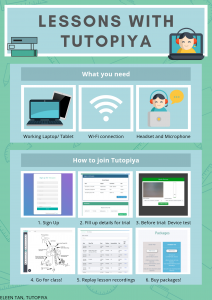
HOW TUTOPIYA PROVIDES ONLINE TUITION FOR BOTH IGCSE & Sat
Tutopiya is an international online tuition agency.
Offer ane to ane home tuition for Cambridge and Edexcel IGCSE and SAT curriculums.
It boasts a reputation of supporting students in Singapore and across the globe.
Students from the UAE, UK, US, Australia, India, China, Sri Lanka, and South Africa have plant success through Tutopiya.
Expatriate students in Singapore accept ever found Tutopiya helpful.
With a team of expert researchers, educators and experienced IGCSE & Saturday tutors, Tutopiya is your ultimate IGCSE and Sabbatum portal.
This platform offers:
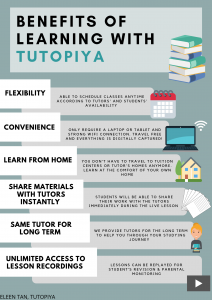
- Live tutoring
- Gratis LIFETIME ACCESS to IGCSE and Sat subject's, class preparation resources, past papers, lesson plans.
- Assessment guides
- Recorded lessons made by expert tutors.
To help students accomplish their dream grade, a diversity of approaches are used:
- Customized lesson plans based on students' level of knowledge in a bailiwick.
- To maximize a pupil's strengths and amend grades, tutors carefully empathise the educatee'south abilities and positive characteristics.
- Tutors identify student'due south weaknesses and gaps in their noesis to cover all aspects of the syllabus.
- Constructive feedback and back up for parents and students.


Source: https://www.tutopiya.com/blog/british-vs-american-education-systems-with-reference-to-igcse-and-sat/
0 Response to "what is the difference in school choice and board to board transfer"
Post a Comment